Vincent van Gogh: the twelfth house and the fire of inner vision
His chart helps speak about the fine boundary between inspiration, solitude, and the need to express the invisible.
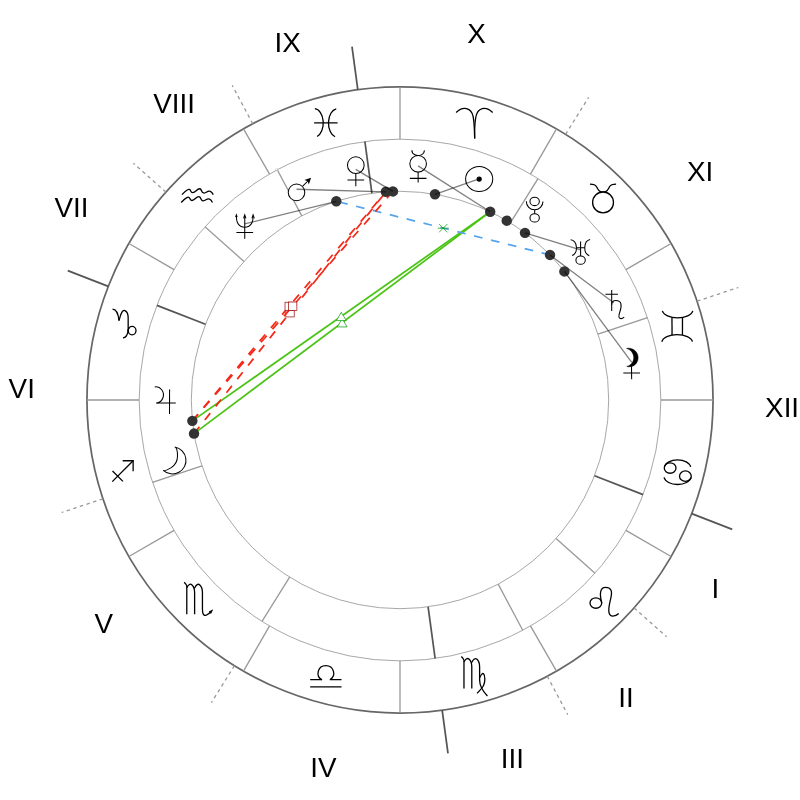
Vincent van Gogh's chart is a way to speak about the twelfth house without romanticizing suffering. This is the house of the invisible: solitude, inner life, and what cannot be easily explained in ordinary language. In a strong chart, it can become not only isolation, but a source of image.
The twelfth house as an inner studio
The twelfth house is often read as loss or withdrawal. That is too narrow. It shows where a person touches what has no simple form: memory, pain, the unconscious, mystical feeling, other people's suffering, images rising from depth.
For an artist, this zone can become an inner studio. The visible world is not merely copied; it passes through intense inner sight. Color, line, and movement begin to express not just an object, but a state. The twelfth house does not only hide life. It translates life into another language.
Inspiration and the risk of dissolving
The strength of the twelfth house is the ability to see what others cannot name. But that ability needs a careful form. If the inner current is too strong, the person needs craft, rhythm, body, and repetition, or inspiration can become exhaustion.
In van Gogh's chart, the lesson is that the invisible asks to be expressed materially. Canvas, paint, hand, repetition, and work help the psyche carry the image outward instead of being consumed by it.
What to take back to your chart
If your twelfth house, Neptune, or Pisces is emphasized, ask: what do I sense before I can explain it? What form can hold the invisible for me: writing, music, prayer, therapy, painting, sleep rhythm?
Van Gogh's chart does not say that pain is necessary for art. It says something more precise: when there are too many images inside, they need form, or they may begin to live against the person.
Want to read this in your own chart?
Open in bot